
IMF members will also be examining whether China's heavy intervention in the yuan market was befitting of a freely convertible reserve currency

The rating outlook change is relevant now, as the US Federal Reserve is set to end its monthly bond-buying programme in October.
The world economy is going through a tough phase.

Singh emphasised that the Indo-Pacific is no more a maritime construct, but a full-fledged geo-strategic issue, and that the region is facing "a complex web" of security challenges, including boundary disputes and piracy.

'We like certain stocks from banking, insurance, retail, hospitals and capital goods.' 'Though some of these stocks may seem expensive, they will compound well over the long term, thus justifying their current multiples.'

The Reserve Bank on Wednesday projected retail inflation to ease to 5.3 per cent in next fiscal from 6.5 per cent this year on assumptions of lower imported inflation, even though core inflation remains sticky. The RBI's inflation outlook for current fiscal has improved from 6.8 per cent projected earlier, to 6.5 per cent, on the back of steeper than expected decline in vegetable prices and Indian basket of crude at $95 a barrel. "Looking ahead, while inflation is expected to moderate in 2023-24, it is likely to rule above the 4 per cent target.

In Q1, India's GDP shrank by a staggering 24 per cent year-on-year amid the imposition of one of the most stringent global nationwide lockdowns.

The services sector growth in India rose to a 13-year high in September on sharp increase in new business amid strong demand conditions, and job numbers continued to increase as overall business mood improved, a monthly survey said on Thursday. The seasonally adjusted S&P Global India Services PMI Business Activity Index rose from 60.1 in August to 61 in September, signalling a sharp upturn in output. In Purchasing Managers' Index (PMI) parlance, a print above 50 means expansion while a score below 50 denotes contraction.

Amid rupee sliding below 64 to a dollar, global agency Standard & Poor's on Tuesday said it will maintain negative outlook for the country as currency depreciation is adversely impacting investor confidence.

Have the markets already played out their dynamics before the economy has even properly taken off? Are we now destined for a period of mediocre returns despite a strong economy? asks Akash Prakash.

Substantial gains can still be made with good policies and initiatives.

'The Budget will be positive, continuing on the path of growth taken so far.'
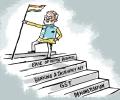
As the Ukraine conflict impacts the global GDP, India is projected to grow by 6.4 per cent in 2022, slower than the last year's 8.8 per cent but still the fastest-growing major economy, with higher inflationary pressures and uneven recovery of the labour market curbing private consumption and investment, according to a UN report. The UN Department of Economic and Social Affairs said in its World Economic Situation and Prospects (WESP) report released on Wednesday that the war in Ukraine has upended the fragile economic recovery from the pandemic, triggering a devastating humanitarian crisis in Europe, increasing food and commodity prices and globally exacerbating inflationary pressures. The global economy is now projected to grow by only 3.1 per cent in 2022, down from the 4.0 per cent growth forecast released in January 2022.
International Monetary Fund has cut its 2003 global growth forecast to 3.2 per cent from 3.7 per cent due to the Iraq war and stock market declines, and is particularly worried about weak German growth.

Growth forecast has been lowered owing to tepid growth in the first half of 2017-18, the lingering effects of demonetisation, transitory challenges of GST, and some risks to agriculture stemming from a spotty monsoon.
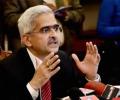
Reserve Bank Governor Shaktikanta Das has pitched for policy support from all sides -- fiscal, monetary and sectoral -- to nurture recovery of the economy hit by the second wave of the coronavirus pandemic. The dent on economic activity due to the second wave of the pandemic during April-May necessitated continuation of monetary measures to support the process of economic recovery to make it durable, Das had said while participating in the meeting of the Monetary Policy Committee (MPC) earlier in the month. "Overall, the second wave of COVID-19 has altered the near-term outlook, and policy support from all sides - fiscal, monetary and sectoral - is required to nurture recovery and expedite return to normalcy," Das said, as per the minutes of the meeting released on Friday.

OPEC hopes lower fuel prices will stimulate more demand in the long run

Amid China's economic slowdown, the country's economic challenges may increase manifold and its economy may be hit harder in the wake of the Ukraine-Russia crisis.

The downgraded World Bank forecast follows a similar move by the International Monetary Fund, which cut its growth forecasts two months ago
In a year that saw inflation touching a 13-year high of 12.82 per cent in August, the 150 million cases beer market grew by 15 per cent, according to All India Breweries Association figures. The wine segment, which has a total market size of around 1.5 million cases, posted even a higher growth rate of 30 per cent, as per International Wines and Spirits Record, while other alcoholic beverages, with a market size of 190 million cases, grew at 15 per cent.

With corruption rankings, the White-Anglo-Saxon-White Caucasian countries have succeeded in discovering a replacement for the old form of imperialistically deracinating the rest of the world, argues Sudarshan Madabushi.

'We are in a sweet spot.' 'Equity, on a standalone basis, will continue to remain the asset class to stay invested in.'
Inflation at 6 per cent was a matter of concern in the evolving macro-economic outlook and the Reserve Bank of India fears that consumer prices could be even higher at 7 to 8 per cent.

The outlook is improving and that mostly reflects the fact that the new government has pledged to prioritise economic reforms.

Indian economy is expected to clock an average growth rate of 6.7 per cent till 2026-27 fiscal driven by domestic consumption, S&P Global Ratings senior Economist (Asia Pacific) Vishrut Rana said on Wednesday. He said the economic growth in the current fiscal is expected to come in around 6 per cent, lower than 7.2 per cent clocked in 2022-23. "We are seeing some headwinds from the trade side which is affecting activity and that is one of the factors that is affecting growth this year," Rana said at a webinar.
"The outlook for exports in 2008-09 may not be as bright as in the past few years with lower projections in world GDP and world imports and exchange rate developments," according to the pre-Budget Economic Survey tabled in Parliament.

'India is an equity market with a breadth and depth of companies to invest in.'

Total holdings of the top eight gold ETFs have risen by 3.8 million ounces so far this year
Govt to strongly pitch for better rating, to argue India has successfully weathered its problems and govt capacity on growth remains high.

'The fiscal deficit target of 3.9 per cent of GDP seems achievable.'

Among the Sensex firms, Larsen & Toubro, UltraTech Cement, JSW Steel, Titan, Bajaj Finance, Wipro, Tech Mahindra and Nestle were the major laggards. Maruti, Power Grid, Axis Bank, State Bank of India, NTPC, HDFC Bank, ITC and IndusInd Bank were the gainers.

Modi attended the 20th ASEAN-India Summit in Jakarta. Secretary-General of ASEAN Dr Kao Kim Hourn also attended the summit.

The Indian services sector growth touched a six-month high in December, supported by a robust intake of new work and favourable market conditions, a monthly survey said on Wednesday. The seasonally adjusted S&P Global India Services PMI Business Activity Index rose from 56.4 in November to 58.5 in December, highlighting the strongest rate of expansion since mid-2022. For the 17th straight month, the headline figure was above the neutral 50 threshold.

lobal output returning to its medium-term growth rate of 4 per cent
S&P upgraded India's credit outlook to 'stable' from 'negative' earlier.

Market participants attribute the stability to the Reserve Bank of India's timely intervention in the foreign exchange market, both in terms of selling and buying dollars.

Fitch Ratings on Monday said the shock to economic activity from the latest wave of COVID-19 pandemic will be less severe than the one in 2020, but recovery is likely to be delayed as economic activity dropped in April-May. The global rating agency said there are growing indications that the latest wave of COVID-19 infections will add to risks among financial institutions (FIs) and anticipates that the Reserve Bank of India (RBI) may introduce additional measures to support the financial sector if indications of economic stress mount.
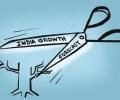
India's real GDP growth will decline marginally to 6.3 per cent in 2024 from the 6.4 per cent estimated for 2023, an American brokerage firm said on Monday. The next calendar year will be of two halves, wherein the government spending before the upcoming General Elections will be the key driver for growth, while after the elections, it will be the re-acceleration in investment growth, especially from the private sector, Goldman Sachs said in a report. From a fiscal year perspective, the brokerage said it expects growth to accelerate to 6.5 per cent for FY25 from the 6.2 per cent it has projected for the ongoing FY24, it added.
 © 2026 Rediff.com - Advertise with us - Disclaimer - Privacy Policy - Sitemap - Feedback - About us - Terms of use - Grievances